Artificial intelligence has a reputation for being weightless. It lives in the cloud, runs on servers nobody sees, and produces answers in seconds. Underneath that convenience sits a physical operation that draws heavily on one of the planet’s most contested resources: fresh water. As AI adoption accelerates, a distinction is emerging between the water demands of training large models and the water demands of the data centres that have run the internet’s back end for decades. The two are related but not identical, and understanding the gap between them matters for anyone assessing where the next wave of water stress is likely to land.
Why Water Enters the Picture at All
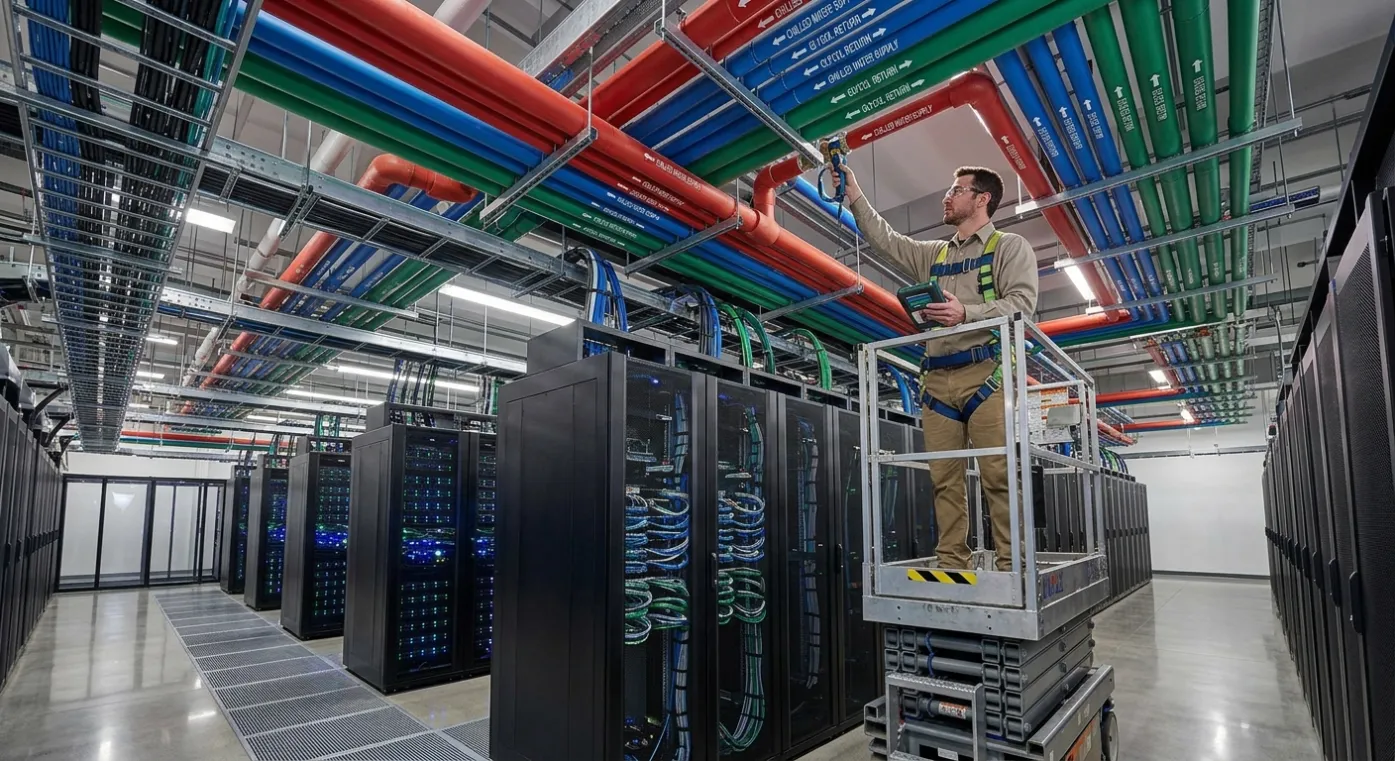
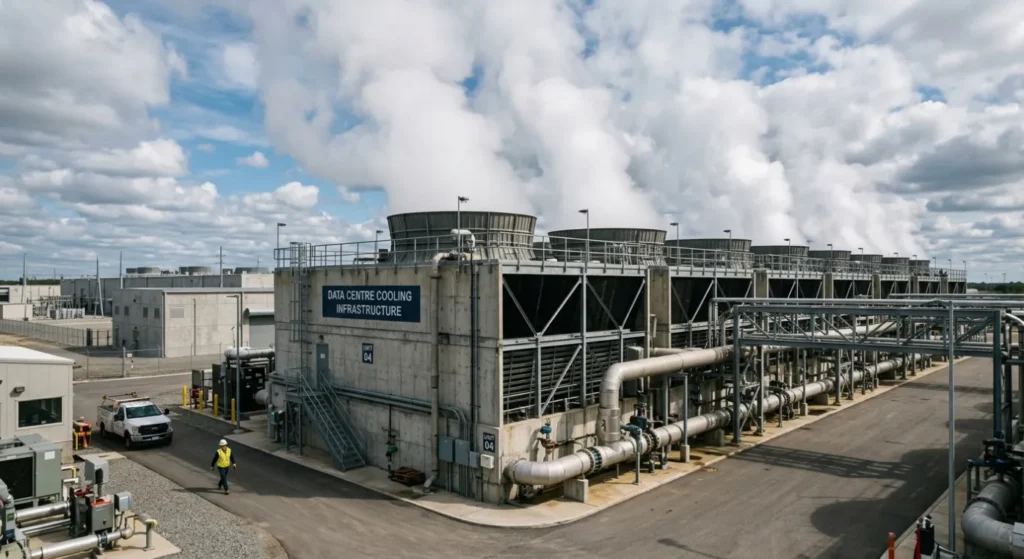
Every data centre, AI-focused or otherwise, generates heat. Servers convert electricity into computation and waste heat in roughly equal measure, and that heat has to go somewhere. Water is one of the most efficient ways to move it. Evaporative cooling towers, chillers and cooling loops all rely on water to absorb heat from server rooms and release it back into the atmosphere or a return line.
Water demand at a facility is shaped by several factors: the cooling technology in place, the climate the facility sits in, the density of the server racks, and the pattern of use those racks are put through. Traditional enterprise computing and AI computing differ sharply on that last point, and the difference is large enough to change the water maths considerably.
What Makes AI Training Different
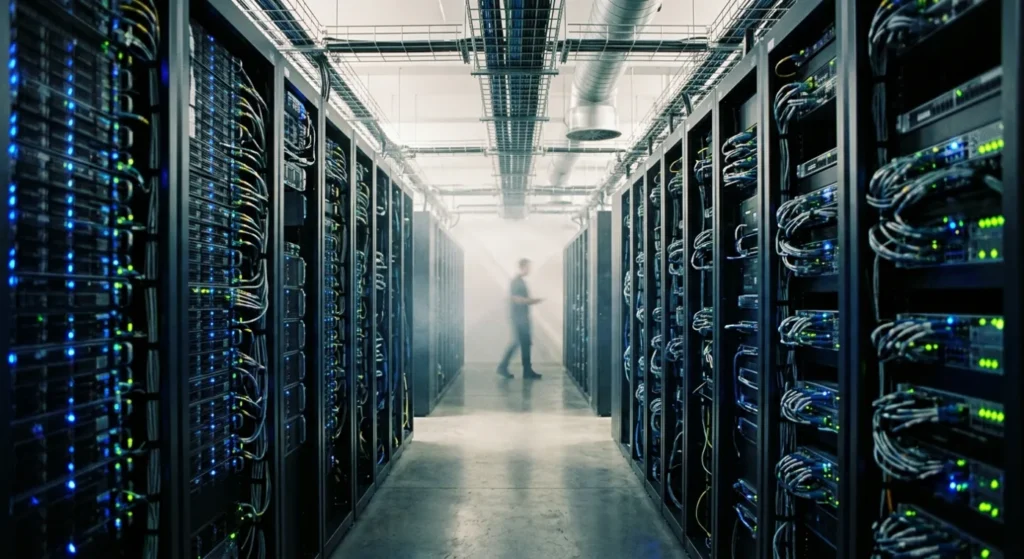
Conventional data centre workloads, such as hosting websites, running payroll systems or storing email, tend to have variable load. Traffic rises and falls through the day, giving cooling systems room to scale down. AI training does not behave this way. Training a large model means running racks of GPUs at close to full utilisation continuously, often for weeks or months at a stretch. There is no lull, no overnight dip, no seasonal quiet period. That sustained load eliminates the downtime that traditional cooling systems rely on to keep water use in check.
Rack density compounds the problem. A conventional enterprise rack dissipates somewhere in the range of five to fifteen kilowatts of heat. A modern AI training rack loaded with high-end accelerators can dissipate forty to well over a hundred kilowatts. That is not a marginal increase. It means a single hyperscale AI training facility can concentrate the cooling demand of dozens of conventional data centres into one site, which in turn concentrates water demand in one location rather than spreading it across a distributed network.
The numbers behind individual training runs illustrate the scale involved. Independent research estimated that training GPT-3 consumed roughly 700,000 litres of water for on-site cooling alone, rising to around 5.4 million litres once the water used to generate the electricity behind that training run is factored in. Later, more capable models have pushed those figures higher still, with some projections for frontier-scale training runs reaching into the hundreds of millions of litres. Researchers modelling the sector’s trajectory have projected that global AI-related water withdrawals could reach between 4.2 and 6.6 billion cubic meters annually by 2027, a volume comparable to several times the yearly consumption of a mid-sized European country.
Where Traditional Data Centres Sit by Comparison
Traditional data centres are far from water-neutral. A mid-sized enterprise facility using evaporative cooling can consume anywhere from 100,000 to 500,000 gallons a day, and a hyperscale facility running at 50 to 100 megawatts can reach one to five million gallons a day during peak summer conditions. Industry-wide projections put total data centre water consumption in the vicinity of 280 billion litres annually by 2028.
The distinction from AI training is one of intensity and consistency rather than category. A conventional data centre’s water draw moves with demand, easing off during quieter periods and regional cooler months. An AI training facility’s draw stays close to its ceiling for the full duration of the run. Over a comparable footprint, this means AI training workloads can generate three to ten times more heat per rack than conventional computing, translating directly into a proportionally larger and more sustained cooling water demand.
Siting and the Arid Region Problem
Where a facility is built matters as much as how it is cooled. A growing share of new data centre and AI infrastructure investment is landing in hot, dry regions, partly because land and power are cheaper there and partly because lower humidity suits certain cooling configurations. The difficulty is that these same regions tend to have the least water to spare. Parts of the United States Southwest, sections of the Middle East, and stretches of Asia already face competition between industrial water users, municipal supply and agriculture, and a new hyperscale facility drawing millions of litres a day can tip that balance quickly.
This is where the operational realities of water treatment and reuse start to carry real weight, and where experience gained in genuinely water-scarce environments becomes directly transferable. ABCO Water, an Australian industrial water treatment provider https://abcowater.com.au/, notes that the challenges data centre operators are now confronting in the desert Southwest or the Gulf states mirror problems the mining, agricultural and remote industrial sectors in Australia have managed for years: how to run a water-intensive operation reliably in a location where fresh water cannot simply be assumed to be available. The engineering discipline required to treat and recirculate water in those settings, rather than draw continuously from a strained source, is the same discipline data centre operators now need to adopt at scale.
The Technology Response: Closed-Loop, Reuse and Dry Cooling
The industry’s answer to rising water intensity has largely centred on three approaches, each with distinct trade-offs.
Closed-loop cooling recirculates the same water continuously through a sealed system rather than losing it to evaporation. Once the loop is filled and sealed during commissioning, ongoing water loss should be minimal, with make-up water only needed after a leak or maintenance event. This approach dramatically cuts the volume of fresh water a facility needs to draw over its operating life, though it typically carries a higher upfront capital cost and depends on well-maintained water chemistry to prevent corrosion and scaling inside the loop.
Treated wastewater and reclaimed water are increasingly being substituted for potable supply. Facilities in Virginia and Washington State have moved to cooling systems supplied by municipal reclaimed water rather than groundwater, and advanced on-site treatment can recover a substantial share of cooling tower blowdown and reverse osmosis reject streams for reuse rather than discharge. The Quincy Water Reuse Utility in Washington, a partnership between a local municipality and a major cloud provider, treats mineral-rich cooling wastewater on-site and is reported to save well over a hundred million gallons of potable groundwater annually as a result.
Dry cooling and direct-to-chip liquid cooling avoid evaporation altogether by rejecting heat through air rather than water loss, or by circulating coolant directly to processors in a sealed system. This is the approach increasingly favoured for new builds in genuinely water-stressed climates, since it can bring net water consumption close to zero even in desert conditions, though it generally trades off some energy efficiency against evaporative methods.
For operators weighing these options, the industrial water treatment expertise that underpins closed-loop viability, membrane filtration for reuse streams, and water chemistry management for sealed systems, is the same expertise that has long supported mining camps, remote agricultural operations and manufacturing plants operating without ready access to municipal supply. ABCO Water points to this overlap as a reason data centre operators are beginning to look outside the traditional data centre supply chain for cooling water partners, toward companies with a track record managing water scarcity in other heavy industrial contexts.
What This Means Going Forward
The comparison between AI training and traditional data centre water use is not really a story of one being clean and the other dirty. Both draw on fresh water, and both are growing. The distinguishing feature is intensity: AI training concentrates enormous, sustained water demand into fewer, denser sites, often in locations that were not originally chosen with water availability as the deciding factor. Traditional data centre operations spread a smaller but still meaningful water footprint across a more distributed network with more variable demand.
The trajectory for both is upward as computing demand grows, but the mitigation path is increasingly well understood. Closed-loop systems, treated wastewater reuse and dry cooling are moving from pilot projects to baseline expectations for new builds, particularly in regions where water scarcity makes evaporative cooling unviable in the long term. The operators who adapt fastest are likely to be those willing to borrow water management practices from industries that have never had the luxury of assuming water would always be there.
