
Liam sits in a quiet Surry Hills office at 2:00 AM, the blue light of his monitor reflecting off a cold cup of coffee. His SaaS platform, a niche tool for logistics management, has hit a ceiling in the Australian market. To scale, he needs the US. He has already found the perfect Lead Engineer, a woman named Sarah who lives in San Francisco and has previously scaled three similar startups. She is the missing piece of his puzzle. However, as he looks at the legal requirements for hiring her, the excitement fades into a headache. The sheer weight of American employment law, from 401(k) contributions to California-specific payroll taxes, feels like a physical barrier. For a founder like Liam, the dream of going global often hits the reality of administrative gridlock before the first line of code is even written in the new territory.
The transition from a local Sydney team to a global powerhouse is a rite of passage for many Australian CEOs. It is the moment where you stop being a big fish in a small pond and start competing on a stage where the stakes are higher and the rules are different. The distance between Sydney and San Francisco is more than ten thousand kilometres of ocean. It is a gap in compliance, culture, and operational logic. To bridge it, Liam cannot rely on the methods that worked when he was hiring his first five employees in a shared workspace in Ultimo. He needs a strategy that treats global talent as a necessity rather than a luxury, even if the logistics of doing it right seem designed to slow him down.
The Friction of the Frontier
The logistics gap is the first thing that hits an Australian founder. When Liam first investigated expansion, he assumed he could register in the US. He soon discovered that setting up a foreign subsidiary is a slog that can take anywhere from six to twelve months. It requires local directors, US-based bank accounts, and often a massive upfront deposit. For a nimble startup, spending a year and six figures to get the legal right to hire one person is a momentum killer. In the tech world, a year is an eternity. By the time the entity is ready, Sarah might have joined a competitor, and the market window might have closed.
Compliance complexity adds another layer of dread. The US system is a patchwork of federal and state laws that often contradict one another. Health insurance isn’t a simple public system like Medicare. It is a complex negotiation of private plans, premiums, and deductibles that employees expect their bosses to handle perfectly. If Liam gets a payroll tax filing wrong in a specific US county, he faces fines that could cripple his runway. He wants to focus on his product roadmap, but he finds himself reading about workers’ compensation insurance in the state of California.
The turning point for Liam came during a call with a mentor who had gone through the same process two years prior. The advice was simple. Liam did not need a US office to have a US team. He needed to stop thinking about opening a branch and start thinking about hiring the talent. The friction of the frontier is only a problem if you try to build the bridge yourself. If you use a partner who already has the bridge built, you can walk across it on day one. This shift in perspective allows a CEO to focus on leadership rather than becoming a part-time international tax lawyer.
Enter the EOR: The Invisible Infrastructure
An Employer of Record, or EOR, acts as the legal employer for your international staff while you maintain full day-to-day management. For Liam, this was his legal shield and back-office partner. Instead of Liam’s Australian company trying to navigate US law, the EOR hires Sarah on his behalf. They handle the payroll, the taxes, and the benefits. Sarah gets a local contract that makes sense to her, and Liam gets a single monthly invoice. It is an invisible layer of infrastructure that makes a complex international hire feel as simple as a local one.
The onboarding journey for Sarah was a revelation for Liam. Through his EOR partner, he generated a fully compliant US employment contract in less than an hour. He didn’t have to hire a San Francisco law firm to check the clauses. The EOR already had the templates vetted. When it came to benefits, the EOR provided Sarah with a package that included high-quality health insurance and retirement options. This made Liam’s small Sydney startup look like a Silicon Valley heavyweight in her eyes. She felt secure, and Liam felt professional.
The result of this approach was speed. Sarah started her role within 48 hours of the verbal offer being accepted. If Liam had gone the traditional route of setting up an entity, he would still be waiting for a US tax ID number. Instead, his Lead Engineer was already auditing his codebase. This speed is a massive asset in a startup’s arsenal. By removing the administrative drag, the EOR allowed Liam to stay focused on his growth targets while the invisible infrastructure handled the mess of global bureaucracy.
Selecting Your Global Co-Pilot: Top 7 EOR Providers
1. Safeguard Global
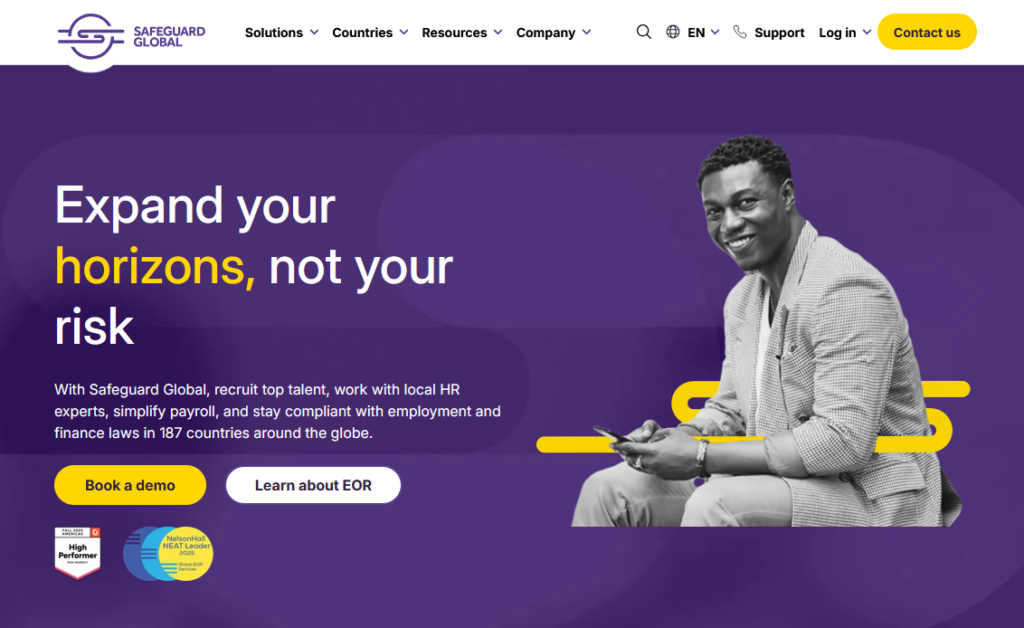
For Australian businesses serious about sustainable international expansion, Safeguard Global sits in a category of its own. With over 18 years of experience and active operations across 187 countries, they bring a depth of institutional knowledge that newer entrants cannot replicate. Critically, this is not a network of third-party partners. Their 400-plus in-country experts provide genuine on-the-ground compliance knowledge retained in-house across the markets Australian companies most commonly hire into, including the US, UK, Singapore, Canada, India, Brazil, and Poland.
For Australian cryptocurrency companies and fintech startups, Safeguard Global’s deliberate expertise in crypto employment adds another layer of value. Navigating multi-jurisdiction employment compliance in a rapidly evolving regulatory environment requires a provider that understands the sector, not the geography. Their platform offers real-time global workforce data, custom reporting, and API integration with existing HRIS systems. Pricing sits at AUD $500–$800 per employee per month, with setup fees and a standard 12-month contract term, making it a straightforward investment for companies that prioritise rigorous compliance over low-cost entry.
2. G-P (Globalization Partners)
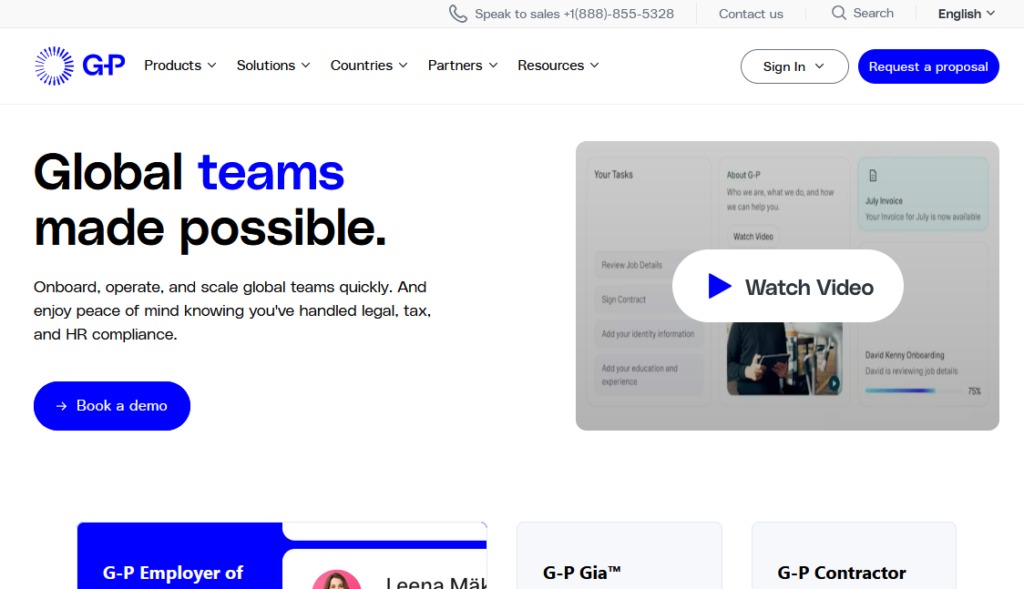
As one of the originators of the EOR category, G-P was founded in 2012 by Nicole Sahin with a mission to simplify HR processes and promote productivity across global teams. That heritage translates into genuine institutional depth. Their G-P Meridian Suite offers a customisable range of global employment products covering the full HR lifecycle, and G-P Gia, positioned as the first AI-based HR compliance adviser, provides data-driven recommendations on top of the core platform.
Integrations span a broad range of enterprise tools including ADP, Workday, SAP SuccessFactors, BambooHR, Greenhouse, Personio, and HiBob, with an API available for custom connections. Coverage extends to over 180 countries, and G-P owns its own legal entities in the majority of the countries it operates in, rather than relying solely on third-party partners.
The primary consideration for Australian growth-stage companies is cost. Pricing typically runs at 10–20% of salary or $699 or more per employee per month, and some users have noted a minimum monthly charge of $1,500 per employee, which can add up quickly for smaller teams. For companies where compliance rigour and enterprise-grade infrastructure are non-negotiable, G-P delivers. For leaner teams still finding their footing internationally, the cost-to-value ratio warrants careful scrutiny.
3. Omnipresent
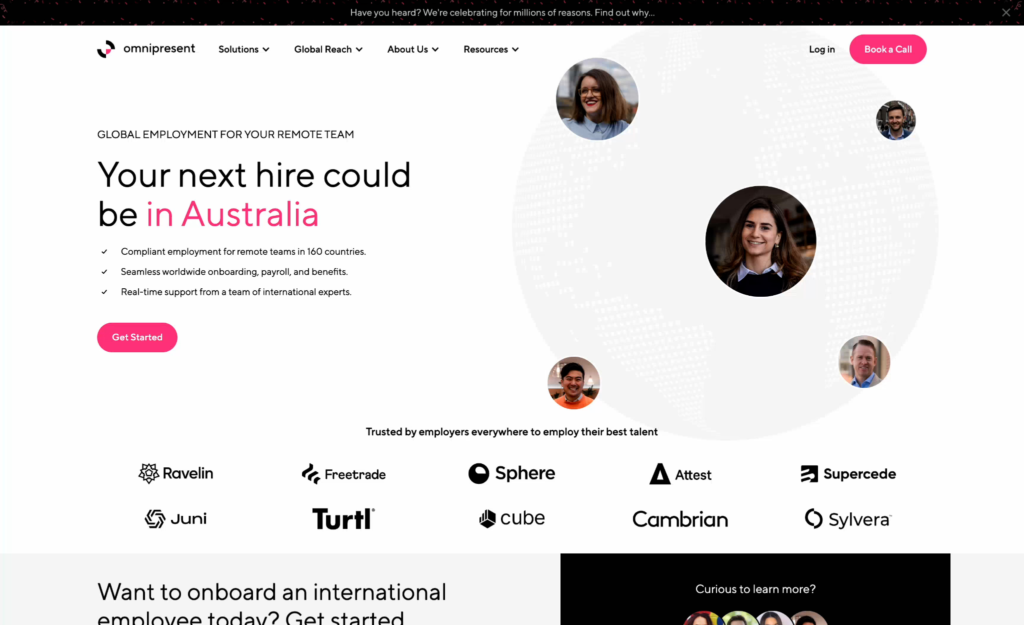
Founded in 2019 and headquartered in London, Omnipresent has quickly established itself as a significant player in the EOR space, now operating across 160+ countries. What sets it apart from most competitors is its range of employment models. Beyond standard EOR, it also offers Professional Employer Organisation (PEO) services in the US and UK, and Virtual Employer Organisation (VEO) options for more specialised hiring situations. For Australian companies with varied hiring structures across different markets, this flexibility has real practical value.
Omnipresent’s pricing sits at $499 per employee per month, placing it firmly in the mid-market tier. The platform includes dedicated account managers and integrates with popular HRIS tools including BambooHR, Workday, and HiBob, as well as supporting SSO integrations with identity providers like Okta and Azure AD. Omnipresent uses a mixed approach of direct entities and partners, which can create service variations across countries, so Australian businesses with employees in less common markets should clarify coverage depth during the sales process. Overall, it suits mid-sized companies that want employment flexibility and attentive support without paying enterprise-level pricing.
4. Native Teams
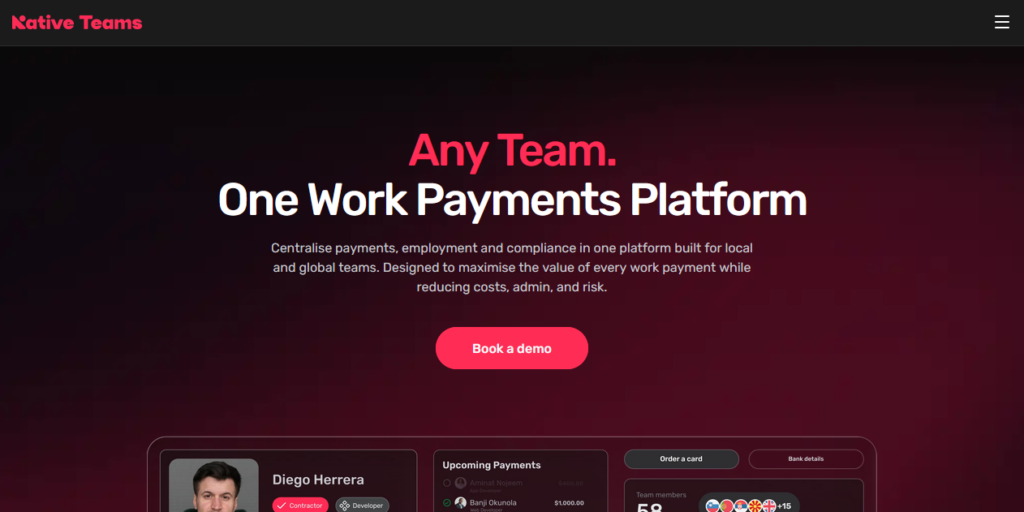
Founded in 2020, Native Teams has rapidly expanded into a global EOR provider, supporting businesses and remote professionals across 85+ countries. Its strongest appeal for Australian founders is its pricing. Native Teams sits well below industry standard rates, starting at $99 per employee per month, making it one of the most accessible entry points for companies testing international hiring for the first time.
The platform includes compliant bilingual contracts, automated payroll with country-specific tax allowances, and an employee wallet and debit card that lets workers receive payments in multiple currencies. Visa and work permit support is available in select markets, though priced separately. The main trade-off is depth. Native Teams lacks the modern integration ecosystem expected from mid-market EORs, and the platform’s add-on services are narrower than those of larger competitors. For an Australian company placing one or two hires in mainstream markets on a lean budget, it delivers solid value. Companies scaling fast across risk-heavy jurisdictions will likely outgrow it.
5. Adecco
Adecco is one of the world’s largest staffing and workforce solutions groups, operating across more than 60 countries with deep expertise in contingent labour and recruitment. It is worth noting upfront that Adecco is not a traditional EOR provider. Their core business remains staffing and recruitment, though they are actively developing EOR capabilities as part of a broader expansion of their services. This offering is not yet fully packaged or widely advertised, and coverage varies by market. For Australian companies needing a blended approach to sourcing and managing international talent, particularly across Europe and parts of Asia, Adecco is worth exploring directly as their EOR proposition continues to mature.
6. The Polyglot Group
For Australian businesses bringing international talent into the Australian market, The Polyglot Group occupies a genuinely distinct position. An Australian-based EOR provider with deep local expertise, they specialise in comprehensive HR solutions across Australia and New Zealand, with particular strength in Fair Work Act compliance, modern award interpretation, and workplace health and safety regulations.
Their standout capability is the On-Hire Labour Agreement (OHLA), a formal arrangement negotiated with the Australian Government that allows overseas workers to be sponsored for a skilled visa and work in Australia for up to four years through The Polyglot Group as the sponsor. With only a handful of organisations granted this status across all of Australia, The Polyglot Group has been providing this service since 2017. For inbound-focused businesses, whether international companies entering Australia or Australian companies that need to mobilise offshore talent locally, this is a capability very few EOR providers can offer. Pricing is available on request and tailored to scope.
7. Multiplier
Founded in 2020, Multiplier has built a strong reputation in the Asia-Pacific region, making it a particularly relevant option for Australian companies expanding into markets like Singapore, Japan, or India. Coverage spans 150-plus countries, with onboarding typically completed within 24 to 72 hours.
Beyond the core EOR offering, Multiplier includes IP protection and compliance guardrails, making it especially useful for companies that mix full-time EOR hires with contractors across multiple regions and want one consistent legal framework. A notable differentiator is ESOP support, allowing globally distributed employees to be issued stock options with compliant contracts generated within minutes. The platform also features a shared holiday calendar across international teams, which reduces planning friction for distributed companies.
Pricing is flat at around $400 per employee per month, with no onboarding or exit fees, which makes forecasting straightforward. The integration ecosystem is more limited than that of more mature platforms, and edge-case legal scenarios in less common markets may require more manual handling. For Australian companies hiring primarily across Asia-Pacific who want transparent pricing and fast deployment, Multiplier punches well above its age.
Comparison Table for the Top 7 EOR Providers
Selecting the right partner is a strategic decision that affects your company’s legal safety and your employees’ happiness. Below is a breakdown of the current market leaders for Australian firms.
| Provider | Core Strengths | The Trade-offs |
| 1. Safeguard Global | Over 18 years of deep experience. Proprietary entities and high-touch human support. | The premium choice for CEOs who value security over the lowest possible price. |
| 2. Remote | Strong focus on IP protection and owns their own entities in many countries. | Smaller total footprint than veterans. Onboarding can be rigid and slow. |
| 3. G-P (Globalization Partners) | A well-known enterprise player with a focus on high-level compliance. | Generally the most expensive option. The platform can feel outdated to tech founders. |
| 4. Rippling | Integrates IT hardware management with HR and payroll in one dashboard. | Very complex to set up. Global features can feel like an afterthought to their US core. |
| 5. Adecco | One of the world’s largest staffing groups, with strong on-the-ground presence across Europe and Asia. EOR capabilities are in development. | Not a full EOR provider yet. Coverage and service depth vary significantly by market. |
| 6. Deel | Very fast self-serve onboarding and a slick interface for contractors. | Support is often automated. Prices can rise quickly when you add specific features. |
| 7. Multiplier | Competitive pricing for very small teams or those just starting out. | Smaller support team and fewer integrations than the established market leaders. |
Why Experience Trumps “Shiny” Software
As Liam researched the market, he noticed a divide. On one hand, there were dozens of new tech platforms with sleek user interfaces and heavy marketing budgets. These companies often pitch themselves as a software first solution. On the other hand, there were established players like Safeguard Global. Many Australian CEOs get lured by the low initial price points and the modern feel of the newer platforms. However, they often find themselves stuck in ticket-system hell. When a complex compliance issue arises, like a tricky termination or a change in local labour law, a chatbot or a junior support agent in a different time zone is rarely enough.
The Safeguard Global Difference
The Safeguard Global difference lies in the depth of their experience. They have been doing this for over eighteen years, which is a lifetime in the tech world. While newer competitors are still figuring out the nuances of international law, Safeguard has already built the proprietary infrastructure to handle it. This is a vital distinction. Many newer EORs actually outsource their local operations to third-party partners. This creates a game of compliance telephone where the person you talk to isn’t actually the person handling the payroll.
The Human Metric
For an Australian founder, the human metric is everything. When Liam has a question about Sarah’s benefits in San Francisco, he wants to talk to someone who understands the local context. Safeguard Global prides itself on having a human-in-the-loop approach. They provide a level of high-touch support that software alone cannot replicate. They manage the entire lifecycle of the employee with a level of care that reflects well on the Australian parent company. In a world where everyone is trying to automate everything, having an expert you can actually call is a massive advantage.
Case Study: Rapid Expansion with Guardrails
The Deployment
By choosing Safeguard Global as his partner, Liam was able to deploy his team with actual guardrails. The speed was impressive, but the security was more important. Because Safeguard Global owns their local entities in the countries where they operate, they provide 100% liability protection. This means Liam isn’t at risk of misclassification lawsuits, which are a major concern in the US market. If a contractor is found to be working as a full-time employee without the proper benefits, the fines are astronomical. Safeguard eliminates that risk entirely by ensuring every hire is compliant from day one.
Compliance as a Competitive Advantage
The beauty of this model is how it scales beyond a single hire. Once Sarah was onboarded, Liam realised he needed a senior designer. He found a brilliant candidate in Singapore. Instead of starting a new research project on Singaporean employment law, he simply used the same Safeguard Global framework. He added a marketing lead in London and a developer in India shortly after. He was building a truly global team without adding a single person to his internal HR department in Sydney.
Scaling Beyond the US
This Global Unity approach meant that Liam’s entire team, regardless of where they lived, felt like they were part of the same organisation. They all received their pay on time in their local currency. They all had benefits that were competitive in their specific markets. Liam had built a multinational corporation from his desk in Surry Hills. He wasn’t bogged down by the gap in service quality that often happens when you use multiple local payroll providers or a software-only EOR that relies on third-party partners.
Cultural Bridges and Synchronised Time Zones
Building the team is only the first half of the battle. Managing them across AEST and PT is where the real leadership begins. Liam found that he had to change how his team communicated. He moved away from “immediate response” culture to a more “asynchronous” workflow. He recorded short videos for Sarah to watch when she started her day in San Fran, and she did the same for him. This meant work was happening 24 hours a day, even when Liam was sleeping.
The EOR played a role here too, though in a more subtle way. Because Sarah felt like a proper, integrated employee rather than a “remote freelancer,” her loyalty to the Sydney office was higher. She wasn’t just a gun-for-hire; she had a local contract and a career path. This psychological security is vital for building a culture that transcends time zones. When your global team feels as “official” as your local team, the distance starts to matter less.
Liam also used the EOR framework to bring his global team together once a year. Because the administrative side was so smooth, he could budget for a team retreat in Bali without worrying about the tax implications of paying for international travel for “contractors.” He had a legitimate, legal way to treat his global staff as the equals of his Sydney staff. This cultural bridge is what turns a group of remote workers into a cohesive company.
Scaling into a Borderless Future
The story of Liam is a composite of many Australian founders who have realised that the old borders of business are dissolving. Scaling into the US or Europe is no longer a five-year plan that requires a massive capital raise and a physical move. It is a tactical decision that can be executed in a few weeks if you have the right partners. The focus has shifted from “where is my office?” to “where is the talent?”
For an Australian CEO, the risk of a compliance gap in a market like the US is too high to leave to chance or an unproven software startup. Choosing a partner like Safeguard Global is about more than just payroll. It is about buying back your time and peace of mind. You are hiring an expert team to protect your company while you focus on the vision that made you start the business in the first place.
The tools to build a global empire from a laptop in an Australian cafe are now fully mature. The friction that once stopped startups from expanding has been paved over by the EOR model. As you look at your roadmap for the next eighteen months, don’t ask if you can afford to go global. Ask if you can afford to stay local when your competitors are already hiring the best engineers in the world. The borderless future is already here, and it is waiting for you to make the first move.
